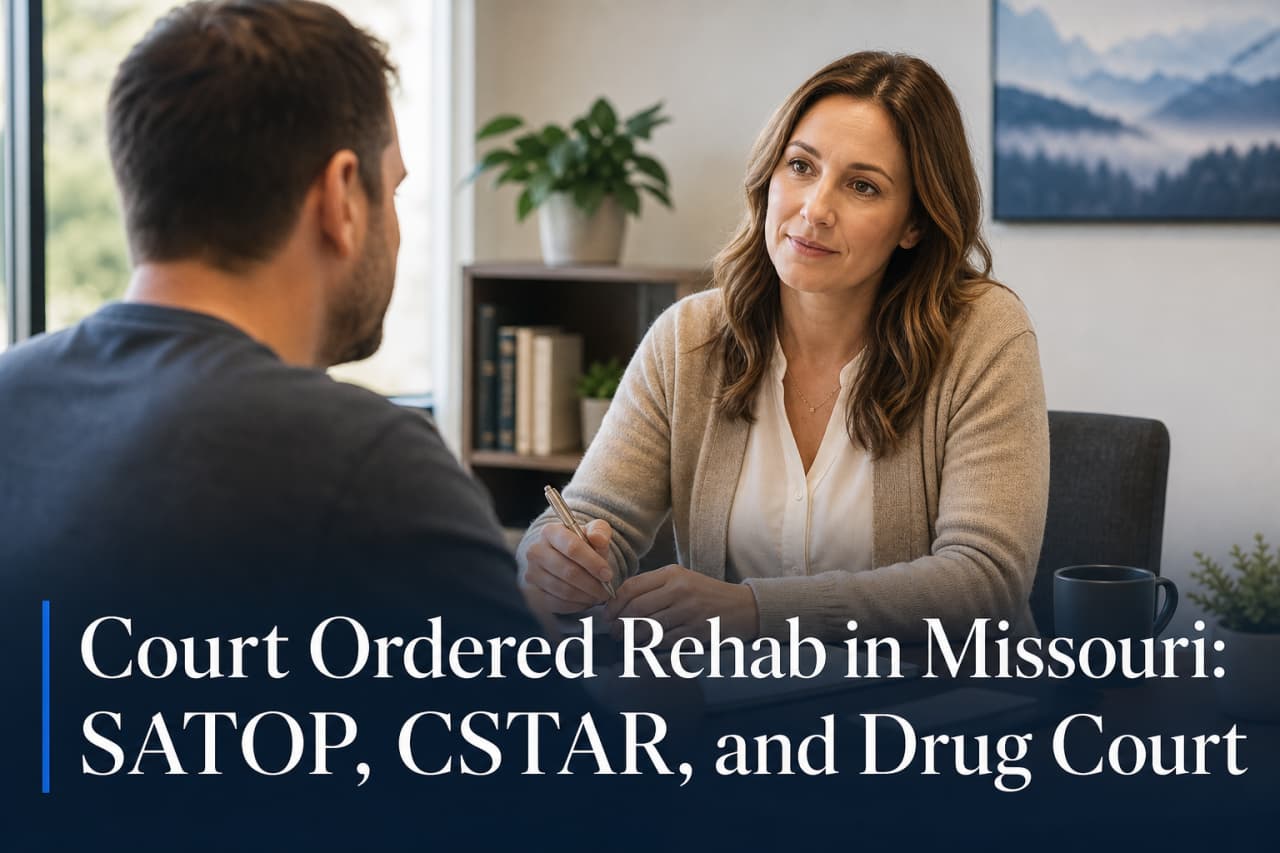
How court ordered rehab in Missouri works: SATOP, CSTAR, probation, and drug court referrals explained, plus the paperwork questions to ask any program before enrolling.
A Missouri judge, a probation officer, or the Department of Revenue can each require substance use treatment as a condition of sentencing, supervision, or getting a driver's license back, and the paperwork usually names a specific program type. Court ordered rehab in Missouri can mean a SATOP course after a DWI, a referral into a state-funded CSTAR program, a treatment condition written into probation terms, or a drug court that supervises recovery directly. Each path has its own rules about who qualifies, who pays, and what proof the court expects to see, and the wrong assumption about any of those can cost weeks.
If you or someone you love just received one of these orders, you are probably trying to answer two questions at once. You want to know what the court will accept, and you want to know whether the program you choose will actually help. Those goals do not have to compete, but they will if you sign up with the first program that says it handles court cases without asking how attendance, progress, and completion get reported back.
The sections below cover the main ways treatment gets ordered in Missouri, where private insurance and private pay fit alongside state-funded options, and the specific questions worth asking any program before you enroll. None of it is legal advice. Your attorney, your probation officer, or the court itself remains the final word on what satisfies your particular order.
What a Missouri Judge Can Actually Order: SATOP, CSTAR, Probation, and Drug Court
Four different requirements get lumped together as court ordered rehab, and each one has a different purpose, a different gatekeeper, and different paperwork. Sorting them out in the first week saves families confusion and, in some cases, a missed deadline that lands the case back in front of the judge.
SATOP stands for Substance Awareness Traffic Offender Program. It is tied to alcohol or drug-related driving offenses and overseen by the Missouri Department of Mental Health. A person completes a screening first, and the screening result determines which SATOP track they are assigned to, from a brief education course up to a longer clinical intervention. Completion is usually a condition of license reinstatement, so the paperwork flows through the Department of Revenue as well as the court. Only providers certified for SATOP can deliver it, which means a general outpatient program cannot substitute for it no matter how good the counseling is. The state's program details are posted by the Missouri Department of Mental Health.
CSTAR is the Department of Mental Health's publicly funded substance treatment and rehabilitation program. It serves people who qualify for Medicaid or who have limited ability to pay, and the care happens at state-contracted providers. CSTAR is a funding pathway rather than a court sentence. A judge or probation officer may point someone toward it because it is the funded option, but eligibility is decided by the provider, not by the court.
Probation is the broadest category. A judge can make substance use or mental health treatment a condition of supervision without naming any specific program. The probation officer then decides whether the program the person chose meets the order, and the person has to keep proof of attendance and progress on file. This is the category where families have the most freedom to pick a private-pay or insurance-based program, and also the most responsibility to confirm that the program will produce records the officer will accept.
Drug court, called treatment court in many Missouri circuits, is the most structured option. Participants agree to frequent drug testing, regular court appearances, and treatment at a level the court team approves. The court, not the participant, usually has final say over which providers qualify, so ask the treatment court coordinator before enrolling anywhere.
Missouri Behavioral Health provides outpatient treatment at our Springfield campus and by telehealth across the state. If you are facing any of these orders, ask us directly how our programs interact with your specific paperwork before you enroll.
Court Ordered Rehab in Missouri: Who Pays and Where Private Insurance Fits
In most Missouri cases the person under the court order pays for treatment, not the court. SATOP is fee-based, so the participant covers the cost of the screening and the assigned education or treatment track out of pocket. CSTAR works differently because it is funded through the Department of Mental Health and built mainly for people who qualify for MO HealthNet or meet the state's financial eligibility rules. Probation and drug court referrals sit in between. The court tells you what kind of treatment to complete, and you or your family figure out how to pay for it.
That is where private insurance becomes the practical question for the families who call us. A court order does not create coverage by itself, and an insurer will not approve a level of care simply because a judge asked for it. Plans generally cover treatment they consider medically necessary, and medical necessity is established by a clinical assessment, not by a court document. If your assessment supports an Intensive Outpatient Program or a Partial Hospitalization Program, many plans will review it on that basis. If the assessment supports standard outpatient care, that is usually what the plan will consider.
Coverage and out-of-pocket costs depend entirely on your specific plan, so no program can honestly promise that your insurance will pay. What a responsible program can do is verify your benefits before you commit. Missouri Behavioral Health verifies insurance before enrollment, and we will walk you through what your plan appears to cover, what your deductible and copays look like, and what a private-pay arrangement would involve if coverage falls short.
One more distinction matters here. A privately funded program may satisfy a probation or drug court requirement, but only if the court accepts that program and the program is willing to provide the documentation the court needs. Whether any program, including ours, accepts court-referred clients or issues attendance and completion records is something to confirm directly before your first appointment. The Missouri Department of Mental Health publishes information on SATOP and CSTAR that can help you understand the state-run options while you compare them with private care.
Choosing a Program That Satisfies the Court Without Sacrificing Clinical Fit
A program can satisfy the court only if it meets the specific requirement written in your order, so read that document closely and match its language to what a provider actually offers. A SATOP referral for an alcohol-related driving offense calls for a state-approved SATOP provider, and general outpatient counseling will not substitute for it. A probation condition that says to complete a substance use assessment and follow recommendations leaves far more room, and that room is where clinical fit starts to matter.
Once the legal requirement is clear, treat the level of care as a clinical question rather than a paperwork question. Missouri Behavioral Health offers Partial Hospitalization, Intensive Outpatient, and standard outpatient care at the Springfield campus and through telehealth across Missouri, and the level a person enters is set by an assessment with a qualified professional, not by what a judge or attorney assumes is appropriate. Someone with a co-occurring depressive disorder and heavy daily use may need PHP even if the court only asked for weekly counseling. Someone with a stable job and a single DWI may need far less structure than a drug court schedule suggests. A program that pushes everyone into the same track regardless of assessment results is telling you the court's checkbox matters more to it than your recovery.
Before you commit, ask any program a few things directly and get the answers in writing where possible. Ask whether they accept referrals from your specific court or probation office. Ask who prepares attendance and progress records, how often those records are sent, and whether a signed release of information is required before anything goes to the court. Ask what happens if you miss a session or test positive, because some programs report immediately and others follow a graduated response. Ask whether telehealth sessions count toward your requirement, since some courts accept virtual attendance and others do not. Missouri Behavioral Health will walk through its own policies on court paperwork when you call, and you should expect the same candor from every provider you consider. The Missouri Department of Mental Health maintains information on SATOP and CSTAR program standards if you want to verify a provider's certification independently.
Questions to Ask Any Program About Attendance Records, Progress Reports, and Completion Letters
Ask who at the program is responsible for sending documentation to the court, what each document contains, and how quickly it goes out after a session or a missed appointment. Those three answers tell you more about whether a program can protect your legal standing than any brochure line about working with the courts.
Start with attendance. Find out whether the program tracks attendance per session or per week, whether a late arrival counts as absent, and whether a telehealth session is documented the same way as an in-person one. Some courts and probation officers accept virtual attendance and some do not, so ask the program whether it has confirmed that with your specific court or officer rather than assuming.
Next, ask what a progress report actually says, because programs vary widely here. One may send a single line confirming enrollment, while another sends a summary of participation, drug screen results, and clinical recommendations. You want to know what gets shared before you sign a release. A report that includes clinical detail can help a judge see effort, but it can also surface information you did not expect to travel.
Then ask about the completion letter, who signs it, what criteria trigger it, and what happens if you step down from a higher level of care partway through. A person who starts in a Partial Hospitalization Program and moves to an Intensive Outpatient Program may need documentation that explains the transition so the court does not read it as an early exit.
Finally, ask about the release itself. A signed release of information should name the exact recipient, the exact records covered, and an expiration date. Confirm whether the release covers the probation officer, the judge, or a treatment court coordinator, since those are not always the same person.
Missouri Behavioral Health provides PHP, IOP, and standard outpatient care at our Springfield campus at 2942 E Battlefield Rd and through telehealth across Missouri. Whether any program, including ours, can accept a particular court referral or provide the specific paperwork your case requires is something to confirm with admissions before enrolling. You can reach our team at 417-771-5305 to ask those questions and to verify your insurance benefits.
FAQ: Court-Ordered Treatment in Missouri
Is SATOP the same thing as addiction treatment?
SATOP is a Missouri Department of Mental Health program tied to alcohol- or drug-related driving offenses, and it is not automatically the same as clinical treatment. Most people enter through a screening that assigns them to an education track or refers them to a higher level of care based on their history and assessment results. If your screening recommends treatment, you will need a program that can meet that recommendation, so ask the program directly whether its services satisfy your specific SATOP requirement. Current program details are published by the Missouri Department of Mental Health.
What is CSTAR, and who qualifies for it?
CSTAR is the state-funded substance treatment and rehabilitation program delivered through providers contracted with the Missouri Department of Mental Health. It is designed for Missourians who meet the state's clinical and financial eligibility criteria, and the provider network is separate from private-pay and private-insurance programs. If you carry private insurance or plan to pay out of pocket, CSTAR eligibility may not apply to you, and a different outpatient option could be a better fit. A program's admissions team can tell you whether it participates in CSTAR before you schedule anything.
Can I choose my own program if a judge orders treatment?
In many cases you can propose a program, but the court or supervising officer has the final say on whether it meets the order. Judges and probation officers often look for a specific level of care, a program that can document your attendance, and sometimes a particular credential or state contract. Bring the exact wording of your order or probation conditions to any program you are considering and ask them to confirm, in writing if possible, that they can meet each requirement. Missouri Behavioral Health can walk you through our outpatient levels of care, and you should confirm with our team and with your attorney or officer whether those services fit your order.
Does completing court-ordered treatment satisfy my legal case?
Completing treatment is usually one condition among several, and it does not resolve a case on its own. The court decides what counts as compliance, which may include documented attendance, negative drug screens, fines, community service, or a formal completion letter. Your attorney is the right person to explain what your specific case requires, and the treatment program is the right place to ask what documentation it does or does not provide.
What happens if I miss sessions during a court-ordered program?
Missed sessions are typically reported to whoever is monitoring your case, and repeated absences can be treated as a violation of your conditions. Every program has its own attendance policy, and every court or drug court has its own tolerance for excused absences, so ask both before you start rather than after a problem arises. If a medical issue, work conflict, or transportation barrier is likely, raise it early so the program and your officer can plan around it.
Can telehealth count toward a court requirement in Missouri?
Some courts and probation offices accept virtual outpatient treatment, while others require in-person attendance or specific verification steps. The answer depends on the judge, the county, and the type of order, so never assume telehealth will be approved without written confirmation. Missouri Behavioral Health offers telehealth across Missouri alongside our Springfield campus, and we ask every court-involved client to confirm with their officer or attorney that a virtual format meets the requirement before scheduling.
If you are sorting through a court order and want to know which outpatient options might fit, we will talk it through without pressure. Call Missouri Behavioral Health at 417-771-5305 for a confidential conversation about treatment options or to verify your insurance benefits. Our campus is located at 2942 E Battlefield Rd, Springfield, Missouri 65804.
About the author
Missouri Behavioral Health
Editorial Team
Helpful educational resources from Missouri Behavioral Health.