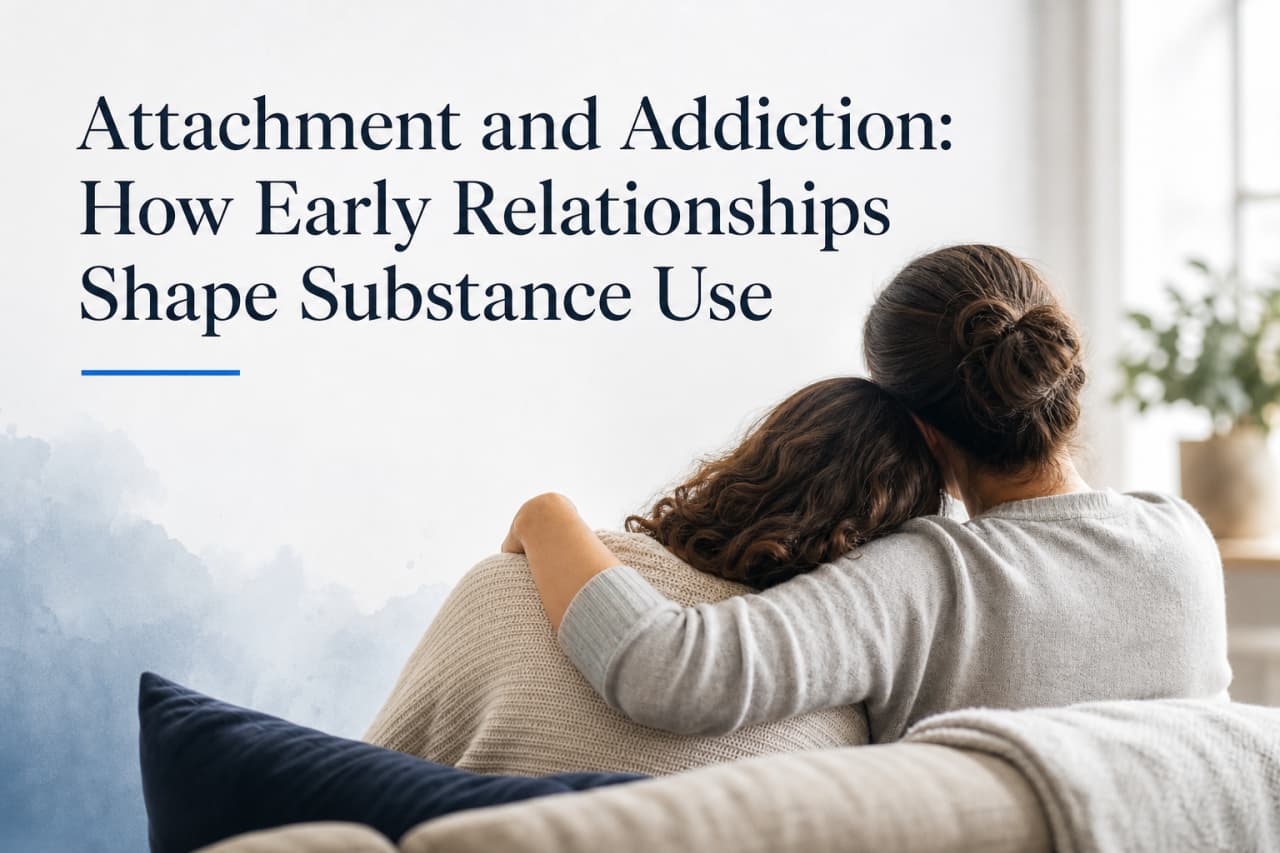
Early caregiving shapes how the brain handles stress and closeness, and insecure attachment can make substances feel like comfort.
Attachment and addiction are linked through a simple pattern: people who learned early on that comfort was unreliable often find that a substance delivers relief faster and more predictably than another person does. That doesn't mean a parent caused anyone's substance use, and it doesn't mean the pattern is fixed. It means the urge to drink or use can carry a job that was once meant for a relationship.
This is Part 2 of our trauma series. In Part 1, we looked at how trauma and substance use feed each other. Here, we focus on one specific thread, the way early caregiving shapes how a person handles stress, closeness, and distress long after childhood ends. Understanding that thread can make cravings feel less like a personal failing and more like a pattern with a history.
We'll explain attachment theory in plain language, describe how insecure attachment can make substances feel like regulation or connection, and outline how attachment-focused therapy works in outpatient care at Missouri Behavioral Health. This isn't a diagnosis, and only a qualified professional can assess what is happening for you or someone you love.
What Does Attachment Theory Say About Attachment and Addiction?
Attachment theory holds that the bonds children form with their earliest caregivers shape how they handle stress, closeness, and comfort for the rest of their lives. British psychiatrist John Bowlby developed the idea in the mid-twentieth century, and researchers since have applied it to adult relationships and to substance use.
The core claim is simple. A child who learns that a caregiver reliably responds to distress tends to develop a secure base, a felt sense that comfort is available and that hard feelings can be survived. A child whose caregiver is inconsistent, distant, frightening, or absent may learn different lessons. Those lessons become internal working models, which are expectations about whether people can be trusted and whether needs will be met.
Insecure attachment is not a diagnosis, and it doesn't mean a parent caused a person's addiction. Caregivers often face their own stress, illness, or unresolved trauma. Attachment theory simply describes a pattern in how people learn to regulate emotion, and that pattern can be relevant when someone later uses a substance to quiet anxiety, numb distress, or feel less alone.
That's where attachment and addiction meet. When a person hasn't had dependable ways to soothe themselves or reach for others, a substance can start to do both jobs quickly. Alcohol may loosen social fear, and other drugs may dull pain or create a short-lived sense of warmth. Over time the brain can come to rely on that relief, which makes the pattern harder to change.
Attachment patterns also aren't fixed. Adults can build what researchers call earned secure attachment through steady, trustworthy relationships, including therapeutic relationships. A qualified professional can assess whether attachment wounds are part of someone's story and which level of care fits.
At Missouri Behavioral Health, our clinical model is trauma-informed and attachment-focused. We offer PHP, IOP, and standard outpatient care at our Springfield campus and through telehealth across Missouri, so treatment can address these patterns while you stay connected to work and family.
Why Can Substances Feel Like Comfort or Connection?
Substances can feel like comfort or connection because they quickly change how the body registers stress, loneliness, and emotional pain, which are the same states a caregiver's soothing presence is meant to settle. When early caregiving didn't reliably calm a child's distress, that child may have had fewer chances to learn that other people can help. Relief then has to come from somewhere else.
Alcohol and other drugs act on brain systems tied to reward, stress, and bonding. The relief can be fast and predictable, which matters to someone whose relationships have felt neither. A drink or a pill doesn't cancel plans, criticize, or leave. For a person with insecure attachment, that reliability can start to resemble a secure base, even though the relief is short-lived and the costs build over time.
The pattern often looks different depending on the person. Someone with anxious attachment patterns may use substances to quiet fear of abandonment or to feel less alone at night. Someone with avoidant patterns may use them to stay emotionally distant while still managing stress without asking anyone for help. Where attachment trauma is part of the picture, substances may dull intrusive memories or a sense of being unsafe in close relationships. These are common patterns, not a diagnosis, and only a qualified professional can assess what applies to you.
None of this means a caregiver caused a person's substance use. Attachment is shaped by many things, including circumstances a caregiver couldn't control. It's one lens for understanding why a substance became so important, and it can make treatment more targeted.
Seeing the pattern also points toward what may help. If a substance has been doing the job of comfort, recovery usually involves building other sources of regulation and connection, such as skills, therapeutic relationships, and group support. At Missouri Behavioral Health, our trauma-informed, attachment-focused outpatient care is designed to support that work at our Springfield campus and through telehealth across Missouri.
How Do Attachment Wounds Overlap With Trauma and Co-Occurring Conditions?
Attachment wounds and trauma often share the same roots, because childhood trauma frequently happens inside the relationships a child depends on for safety. When early caregiving is frightening, unpredictable, or absent, a child may learn that closeness brings danger or that distress will go unanswered. Those lessons can carry into adulthood as attachment trauma, which shapes how a person handles stress, trust, and comfort.
This overlap matters for treatment because the effects rarely stay in one category. Someone with unresolved attachment trauma may also experience anxiety, depression, or symptoms related to past trauma, and each of these can intensify the pull toward substances. Alcohol may quiet a racing mind at night. A stimulant may lift a flat mood. When substance use and a mental health condition exist together, clinicians call them co-occurring disorders, and the two tend to feed each other if only one is addressed.
You can't tell from the outside which came first, and you don't need to sort that out alone. A qualified professional completes an assessment to determine whether a diagnosis applies and which level of care fits. Reading about attachment patterns can help you recognize your own story, but it can't diagnose you.
Missouri Behavioral Health treats mental health conditions, substance use disorders, and co-occurring disorders in the same outpatient setting, with care that is trauma-informed and attachment-focused. That approach treats the relational injury and the substance use together instead of in separate tracks. Our Springfield campus offers a Partial Hospitalization Program (PHP), an Intensive Outpatient Program (IOP), and standard outpatient care, and virtual outpatient treatment is available across Missouri. If you want to understand how trauma shows up in treatment, the first part of this series covers the connection in more detail, and our trauma therapy page describes what working with a therapist looks like.
Group therapy can also matter here. Sitting with others who understand, and being met with steadiness instead of judgment, gives people a repeated, low-pressure experience of safe connection that many have rarely had.
How Does Attachment-Focused Therapy Address Substance Use in Outpatient Care?
Attachment-focused therapy treats the relationship between client and clinician as a working part of treatment, using it to practice trust, emotional safety, and regulation without relying on substances. At Missouri Behavioral Health, this approach sits inside a trauma-informed model delivered through a Partial Hospitalization Program (PHP), an Intensive Outpatient Program (IOP), and standard outpatient care, in person at our Springfield campus or by telehealth across Missouri.
The therapeutic relationship as a corrective experience
Many people with attachment wounds expect that reaching out for help will lead to rejection, criticism, or being a burden. A steady therapist who stays consistent, repairs misunderstandings openly, and doesn't pull away when difficult feelings surface gives a person a different experience to learn from. Over time, that experience can serve as a secure base, a reliable place to return to while trying new ways of coping. Psychotherapy of this kind is designed to support change gradually, and it doesn't require anyone to blame their parents or caregivers.
Building emotion regulation without substances
If a substance has been the main way to calm anxiety, quiet shame, or ease loneliness, removing it without a replacement leaves a gap. Clinicians work with clients to name what they feel, notice where distress shows up in the body, and practice coping skills that can be used between sessions. Motivational interviewing may help when someone feels ambivalent about change, because it starts from the person's own reasons rather than pressure.
Where group therapy fits
Group therapy gives people a place to practice connection in real time. Speaking honestly with peers, receiving support, and working through conflict can challenge the belief that closeness is unsafe or unavailable. Group work is commonly part of structured outpatient programming, and your treatment team determines how it fits your plan.
What to expect from level of care
Treatment plans are individualized and depend on an assessment by a qualified professional. IOP is typically planned at 9 to 15 hours per week, and we confirm actual days and hours after assessment. We don't provide medical detox or inpatient and residential care, so anyone at risk of serious withdrawal should seek medical care first, and we can help with referrals. Family involvement may also be part of treatment when it's clinically appropriate.
Results vary from person to person, and no therapy can promise a specific outcome.
Frequently Asked Questions About Attachment and Substance Use
Does insecure attachment mean my parents caused my addiction?
No, insecure attachment does not mean a parent caused a substance use disorder. Attachment patterns form through many influences, including a caregiver's own stress, illness, finances, and history, along with temperament and life events outside the family. Substance use disorders also involve genetics, environment, and other factors, so no single cause explains them. Attachment-focused therapy looks at how past relationships shaped the way you cope now, and it doesn't ask you to assign blame to anyone.
Can insecure attachment change in adulthood with therapy?
Yes, attachment patterns can shift in adulthood, and clinicians often describe the result as earned secure attachment. Steady, trustworthy relationships, including the one between a person and their therapist, may help people build new expectations about closeness and support. Change is gradual and looks different for each person, and no program can promise a specific result. An assessment with a qualified professional can help clarify what kind of support fits your situation.
Can attachment-focused therapy be done through telehealth or IOP?
Yes, attachment-focused work can take place in both formats at Missouri Behavioral Health. We offer Partial Hospitalization Program (PHP), Intensive Outpatient Program (IOP), and standard outpatient care, in person at our Springfield campus and through telehealth across Missouri. IOP is typically planned at 9 to 15 hours per week, and we confirm the actual days and hours after an assessment. A clinician can talk with you about which level of care and format may be clinically appropriate.
What should I do if stopping alcohol or drugs causes withdrawal symptoms?
Talk with a medical professional before you stop, because withdrawal from alcohol and some other substances can be dangerous. Missouri Behavioral Health doesn't provide medical detox or inpatient or residential care, so we can help you find those services elsewhere when they're needed. If you or someone else is in immediate danger, call 911. For 24/7 mental health or suicide crisis support, call or text 988 to reach the 988 Suicide & Crisis Lifeline. Seizures, confusion, hallucinations, or severe shaking call for emergency care right away.
How do relationships in recovery help replace substance-based coping?
Reliable relationships can give your nervous system a different source of comfort than a substance has. When you can reach out to a therapist, a group member, or a family member during distress and be met with care, that experience may gradually lessen the pull toward using. Group therapy and family involvement are two ways this can happen in outpatient care. These relationships support recovery alongside other treatment, and they don't replace clinical care.
Is addiction considered an attachment disorder by researchers?
No, addiction is not classified as an attachment disorder. Substance use disorders are diagnosed using clinical criteria, and attachment is one lens among several that clinicians use to understand why a person may have turned to substances for regulation or connection. Genetics, trauma, mental health conditions, and environment also matter. For background on substance use disorders, you can visit the National Institute on Drug Abuse.
Call Missouri Behavioral Health at 417-771-5305 for a confidential conversation about treatment options or to verify your insurance benefits. Coverage and out-of-pocket costs depend on your plan, and we confirm availability individually. Our Springfield campus is at 2942 E Battlefield Road, Springfield, Missouri 65804.
About the author
Missouri Behavioral Health
Editorial Team
Helpful educational resources from Missouri Behavioral Health.