What trauma-informed care means in outpatient addiction treatment, what a session can look like, and questions worth asking a provider before you enroll.
Many people who use substances have lived through something painful, and a trauma informed care addiction treatment program is built around that fact from the first phone call to the group room. Staff ask what happened to you instead of what's wrong with you, and they don't push you to share anything before you're ready. At Missouri Behavioral Health, that approach shapes how we run outpatient care in Springfield and by telehealth across Missouri.
Trauma-Informed Care in Addiction Treatment Defined
The term describes a care approach rather than a single therapy. SAMHSA, the federal agency that issues national guidance on behavioral health, publishes a framework for it, and you can read it in SAMHSA's concept of trauma and guidance for a trauma-informed approach.
Trauma-informed care is also separate from trauma-specific therapy such as EMDR. The first describes the setting and the habits of the people in it, while the second is a treatment delivered inside that setting.
In practice, it tends to show up in small, concrete things. A therapist explains what an assessment will cover before asking anything, and you're told what a group session looks like before you walk in. If a question feels like too much, you can say so and move on without being treated as resistant.
It doesn't mean you'll be asked to retell your story in week one. Many people spend early sessions on skills for stress, sleep, and cravings, and decide later, with their clinician, whether and when to work on the trauma itself.
A qualified professional determines your diagnosis and the level of care that fits. Missouri Behavioral Health offers PHP, IOP, and standard outpatient care, and the approach described here applies across all three.
How Trauma and Substance Use Are Linked
Many people first use alcohol or drugs to quiet something trauma left behind, such as a body that won't stop bracing for danger, nightmares that wreck sleep, or memories that surface without warning. The substance can dull the alarm for a while, and over time use can become its own problem layered on top of the original one.
SAMHSA and NIDA both publish material on how trauma-related conditions and substance use disorders can occur together. Each can make the other harder to manage, since stress raises the pull toward use and heavy use can worsen sleep and mood.
That's why a program that looks only at substance use can miss part of the picture. A team that sees both can plan for them together.
You don't need to know your own history in detail to start. An assessment looks at your substance use, your mental health symptoms, and your safety, at a pace you can manage. Your clinician asks what helps and what makes things worse rather than asking you to describe the worst thing that happened. Early work often focuses on coping skills, and you and your clinician decide together when, and whether, to move into processing the trauma itself.
Some people know exactly what happened to them. Others only know that certain places, people, or feelings set them off. Both are workable starting points, and a clinician can help you sort out which patterns are connected to trauma and which aren't.
Principles of Trauma-Informed Care
Trauma-informed programs commonly organize their daily practice around ideas like safety, trustworthiness, peer support, collaboration, choice, and cultural awareness. Those ideas should apply to the front desk and billing staff as much as to therapists.
Safety, Trustworthiness, and Transparency
Safety covers both physical and emotional comfort. That can mean a quiet waiting area, clear explanations before any procedure, and a therapist who doesn't surprise you. Trustworthiness and transparency mean staff do what they say they'll do and explain how decisions get made, including what happens with your records and who sees them.
Peer Support, Collaboration, and Empowerment
Peer support means learning from people who've lived through similar experiences, which is one reason group sessions are part of many programs. Collaboration means your clinician treats the plan as something you build together. Choice means you have real say in the pace, such as whether to attend a particular group or hold off on a topic, and a decline should lead to a conversation about what would make it workable.
Cultural, Historical, and Gender Issues
Trauma looks different across cultures, communities, and genders, and a good program avoids stereotypes and bias. That can include asking about your background without assuming what it means for you, or discussing a clinician's gender if that matters to your comfort.
A principle only counts if every person you meet applies it, so it's reasonable to ask how the team learns and practices these ideas. You can read about our trauma-informed approach, and a clinician can explain how it applies to the level of care you're considering.
What Trauma-Informed Care Looks Like in an Outpatient Session
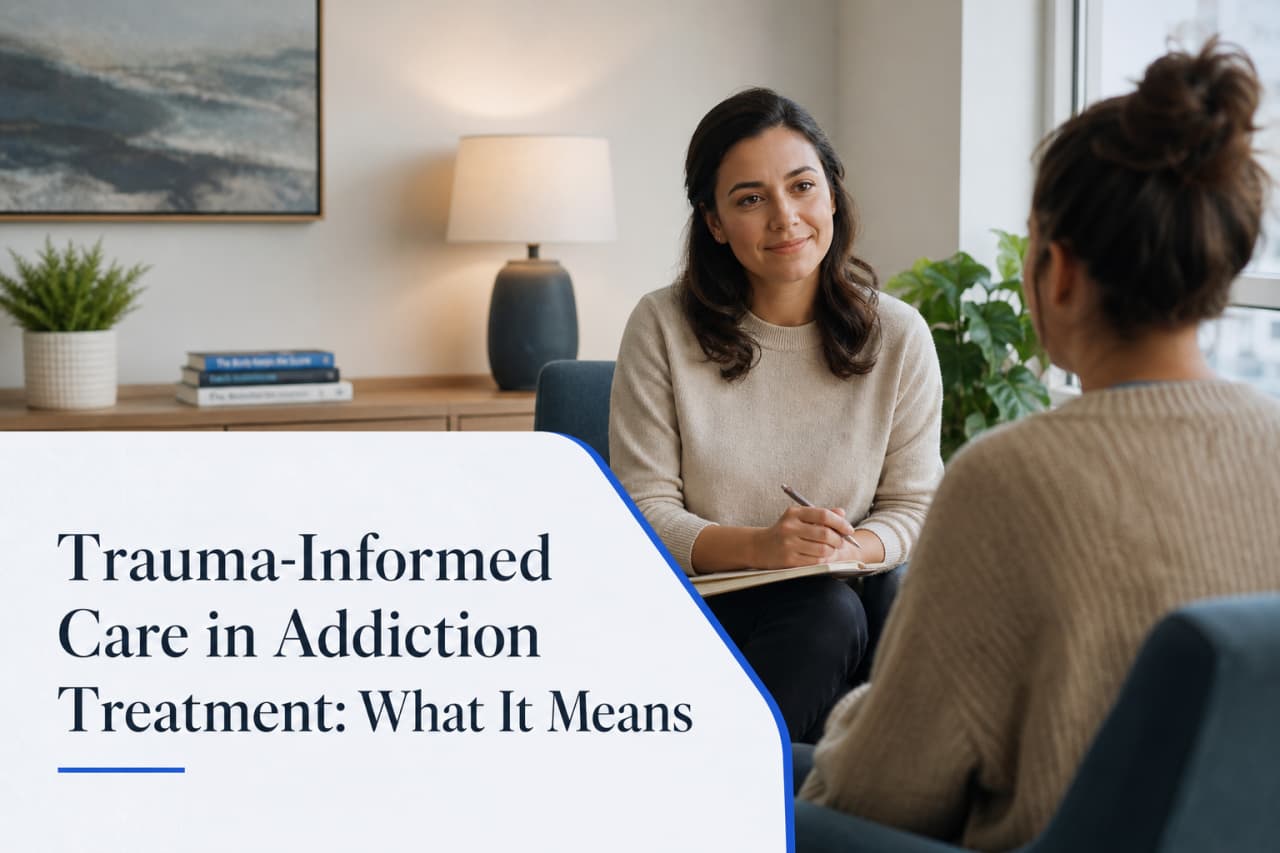
A session might start with a check-in about how the week went rather than a request to revisit your history. Your therapist might ask how you slept, whether cravings showed up, and what stress you ran into at work or at home.
From there, you have a hand in the agenda. A clinician might offer a choice between practicing a grounding skill and looking at what happened when an urge hit, and picking the skill is a full session, not a detour.
Grounding might be slow breathing, naming five things you can see in the room, or pressing your feet into the floor. These skills give you a way to settle when a memory or craving spikes, and you can use them almost anywhere.
Pacing matters too. If a topic raises your heart rate or makes you go quiet, a trauma-informed clinician slows down, checks in, and offers a break or a different subject instead of pushing on because the hour isn't over.
The same habits carry over to telehealth. Your clinician can confirm you're somewhere private, ask whether you want your camera on, and agree on a plan if the connection drops.
If you and your clinician decide to begin trauma processing, such as EMDR therapy, that step is planned ahead of time, with coping skills already in place.
Questions to Ask a Provider About Trauma-Informed Care
A program that's actually trauma-informed can answer specific questions about its daily habits without getting defensive. Before you enroll anywhere, try these on the phone or during an assessment.
- 1"How does your staff learn about trauma?" Look for an answer that covers everyone you'll meet, from the front desk to the therapists.
- 2"Will I have to tell my story to get into treatment?" A good program explains that you set the pace for what you share and when.
- 3"What happens if I say no to a group or a topic?" You want to hear that you can decline and that staff will work out an alternative with you.
- 4"Can I request a clinician of a certain gender?" Even if the program can't always do it, staff should treat the question as reasonable.
- 5"Who can see my records, and how is that explained to me?" Clear, plain answers point to real transparency.
- 6"Do you treat substance use and mental health together?" Programs that split them apart can leave trauma symptoms unaddressed.
Pay attention to how the answers feel, too. Vague language, pressure to decide quickly, or a sense that your questions are an inconvenience tells you something about the program.
Also ask about level of care. Missouri Behavioral Health provides outpatient treatment, so if you need medical detox or a residential setting, we'll tell you plainly and point you toward programs that offer it.
If you'd like to ask us these questions directly, call Missouri Behavioral Health at 417-771-5305 for a confidential conversation about treatment options or to verify your insurance benefits. Coverage and out-of-pocket costs depend on your plan, and we'll check yours with you.
Common Questions
Can trauma-informed care work through telehealth or virtual IOP?
Yes, the same principles carry over to a screen. A clinician can confirm you're somewhere private, let you choose whether your camera stays on, and agree on a plan if the connection drops. Missouri Behavioral Health offers virtual outpatient care across Missouri, so you don't need to live near Springfield.
Should trauma be addressed before or after I stop using?
The order is something you and your clinician plan together after weighing your safety, symptoms, and supports. Many people begin with stabilizing skills while they're still working on substance use, and processing the trauma comes later if it's clinically appropriate. If you're facing withdrawal risk, medical care comes first.
How does attachment-focused therapy fit into this approach?
Attachment-focused therapy looks at how early relationships shaped the way you trust, ask for help, and cope with closeness. The therapy relationship itself can become a predictable place to practice those skills. You can read more in our piece on attachment and addiction.
What if I've been in treatment before and it felt harsh or pushy?
That experience is common, and it's worth telling your next provider about it. A program that confronts, rushes, or pressures people to disclose can feel like a repeat of past harm. Tell the clinician what didn't work, and ask how they'd handle it differently. A good team will treat your answer as useful information, not as a sign you were difficult.
About the author
Missouri Behavioral Health
Editorial Team
Helpful educational resources from Missouri Behavioral Health.