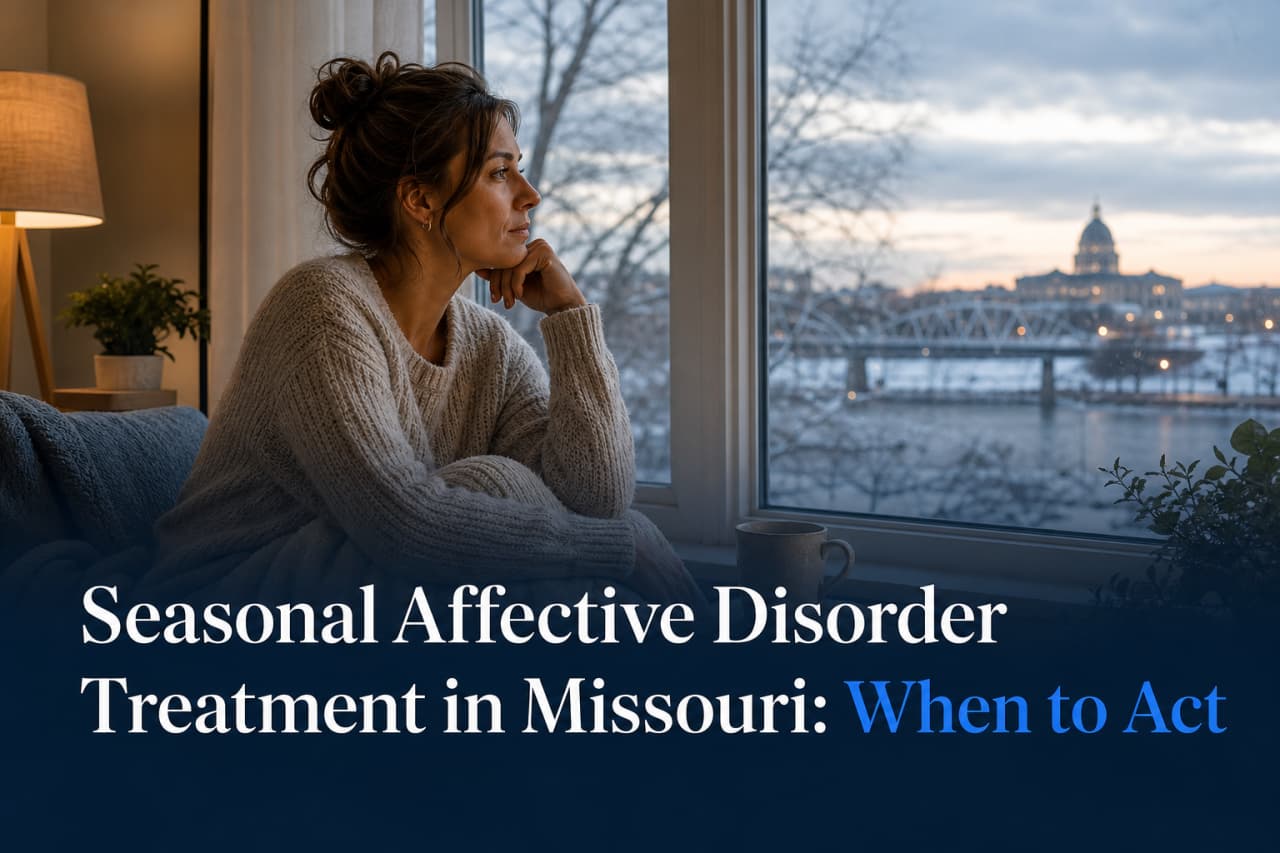
Missouri's shorter days after the fall time change can trigger seasonal affective disorder in some adults.
Seasonal affective disorder is a form of major depression that returns in a seasonal pattern, usually starting in late fall and easing by spring. Seasonal affective disorder treatment works best when it begins early, and in Missouri that often means acting in October or November, before the shortest days of December arrive. If you have noticed the same heavy mood, low energy, and withdrawal every winter, that pattern has a name and real options.
Daylight in Missouri shrinks noticeably after the fall time change, and many people feel it in their sleep, appetite, and motivation within weeks. Evidence-based care includes light therapy, talk therapy such as cognitive behavioral therapy adapted for SAD, and medication prescribed by a qualified clinician. Which of these fits depends on an assessment, not a guess. For a plain overview of symptoms and treatment, the National Institute of Mental Health is a reliable place to start.
At Missouri Behavioral Health, we work with adults and families across Missouri who are weighing outpatient support for depression, and for some, drinking more once winter sets in. This page explains how ordinary winter blues differ from SAD, why shorter days matter, and when a few rough weeks become a reason to reach out. If you or someone else is in immediate danger, call 911. For 24/7 mental health or suicide crisis support, call or text 988 to reach the 988 Suicide & Crisis Lifeline.
Winter Blues or Seasonal Affective Disorder? How to Tell the Difference
The difference comes down to severity, duration, and how much daily life is affected. Winter blues are a mild dip in mood or energy that comes and goes, while seasonal affective disorder is a form of depression that follows a seasonal pattern and interferes with work, relationships, or self-care.
Winter blues might look like feeling sluggish on gray afternoons, wanting more time at home, or missing the longer evenings. You can still get to work, enjoy a good weekend, and feel like yourself on brighter days. These feelings tend to ease without formal treatment.
Seasonal affective disorder symptoms are more persistent. The American Psychiatric Association describes SAD as major depressive disorder with a seasonal pattern, meaning episodes begin and end at about the same time each year, most often starting in late fall and lifting in spring. Common signs include low mood most of the day nearly every day, loss of interest in things you usually enjoy, sleeping far more than usual, carbohydrate cravings, weight gain, trouble concentrating, and hopelessness. Because the diagnosis depends on timing, a person generally has to experience the pattern across more than one winter.
A practical way to sort it out is to ask three things. Has the low mood lasted two weeks or longer, is it affecting your job, your parenting, or your relationships, and are you pulling away from people you normally enjoy? Yes to these suggests the problem is more than winter blues and is worth discussing with a qualified professional.
Family members often notice the shift first. A spouse may see that you stop answering texts every November, or a parent may see a grown child sleeping through weekends. Those observations are useful to bring to an appointment.
Only an assessment can say whether depression is seasonal, and symptoms can overlap with other conditions, including bipolar disorder, thyroid problems, or substance use. Our Springfield team and telehealth clinicians can talk through what you are experiencing and recommend an appropriate level of care. The National Institute of Mental Health also offers a plain-language overview of SAD symptoms if you want to read more before reaching out.
Why Do Shorter Missouri Days Trigger Seasonal Depression?
Less sunlight in late fall can disrupt the body's internal clock and lower the brain's mood-regulating signals, which is why many people in Missouri notice their mood drop after the clocks change in November. Researchers have not pinned down a single cause of seasonal affective disorder, but the leading explanations all involve light. The National Institute of Mental Health describes reduced daylight as a likely trigger that can shift sleep patterns, serotonin activity, and melatonin levels.
The fall time change moves sunset earlier almost overnight, so someone who leaves work at 5:30 p.m. in October may suddenly step into full darkness. Morning light, which helps set the internal clock, also stays scarce through December, January, and February, when days are shortest. Missouri is farther north than many southern states, though not as far north as the places where SAD is most often studied.
Those shifts show up in daily life in specific ways. Sleep drifts, with people sleeping longer yet feeling less rested, and appetite changes bring carbohydrate cravings and weight gain. Energy drops, and interest in work, hobbies, or time with friends can fade. These symptoms tend to return on a seasonal schedule, starting in fall and easing in spring.
Not everyone responds to less light in the same way. A personal or family history of depression or bipolar disorder can raise the likelihood of a seasonal pattern, and so can living with another mental health condition. A mood change that feels like "just the weather" deserves a closer look if it returns each year.
A qualified professional can sort out whether the pattern reflects seasonal depression or another form of depression. Missouri Behavioral Health offers outpatient care at our Springfield campus and through telehealth across Missouri, so people in rural areas can begin that conversation without a long drive. Our depression therapist in Springfield, MO page explains how that support works.
What Seasonal Affective Disorder Treatment Options Have Evidence Behind Them?
Three approaches have the strongest support for seasonal affective disorder treatment: light therapy, psychotherapy (especially cognitive behavioral therapy adapted for SAD), and medication managed by a prescriber. The National Institute of Mental Health describes all three, and a qualified clinician can help decide which fits your symptoms and health history.
Light Therapy
Light therapy uses a light box that gives off bright light, usually 10, 000 lux, while you sit near it for a set time each morning. It is typically started in early fall, before symptoms build, and continued through winter. People with bipolar disorder or eye conditions should talk with a doctor first, since bright light can affect mood and eyes. We don't provide light therapy at Missouri Behavioral Health, so ask your primary care physician or an eye doctor about a device and a safe schedule.
Psychotherapy, Including CBT for SAD
Cognitive behavioral therapy for SAD (CBT-SAD) is a form of talk therapy that usually runs over several weeks. It helps you spot the thoughts that deepen winter withdrawal and plan more activities during the darker months. The skills can last beyond one season because you keep using them the following year. Our clinical approach is trauma-informed and attachment-focused, and our depression therapist in Springfield, MO page explains how individual therapy works with us.
Medications and Vitamin D
Antidepressant medications are an established option, and a prescriber may suggest starting one before symptoms usually begin if you have had repeated winter episodes. Only a licensed prescriber can decide whether a prescription is appropriate for you. Vitamin D gets a lot of attention, but the evidence that supplements treat SAD is weaker than for light therapy, therapy, or medication, so check with your doctor before taking high doses. For our medication policy, see our medication policy page.
Where Outpatient Care Fits
If symptoms affect work, sleep, or relationships, a structured outpatient setting can add support beyond what a light box provides. We offer standard outpatient care, intensive outpatient (IOP), and partial hospitalization (PHP) in Springfield and by telehealth across Missouri. An assessment determines the right level of care, and our mental health treatment in Missouri page outlines how those programs work.
When Should You Seek Help for SAD, Especially If You're Drinking More in Winter?
Seek help when low mood, low energy, or changes in sleep and appetite last longer than two weeks, or when they start interfering with work, relationships, or daily routines. Mild winter blues usually ease with more daylight, movement, and rest. Seasonal affective disorder is a form of depression, and it tends to return each fall and winter until it is treated.
A few signs point toward an assessment sooner rather than later. They include losing interest in things you normally enjoy, oversleeping to the point that a job becomes hard to keep up with, noticeable weight gain or appetite changes, and pulling away from family. If you have had these symptoms in more than one winter, that pattern itself is worth bringing to a professional.
When drinking becomes part of the picture
Some people start drinking more in the darker months to take the edge off low mood or to fall asleep. Alcohol can worsen depression and disrupt sleep, so the habit may deepen the problem it was meant to ease. If you are drinking more from late fall through February, needing more to feel the same effect, or feeling worse the next day in ways that affect work or family, treat that as a reason to reach out now. A family member who sees this pattern can raise it calmly and offer to help find an assessment.
Heavy, regular drinking can also make stopping medically risky. If you have been drinking daily and want to quit, talk with a medical provider first rather than stopping on your own. Missouri Behavioral Health doesn't provide medical detox or inpatient care, and we will refer you to those services when they are needed.
If you're in crisis
If you are having thoughts of suicide or self-harm, don't wait for an appointment. If you or someone else is in immediate danger, call 911. For 24/7 mental health or suicide crisis support, call or text 988 to reach the 988 Suicide & Crisis Lifeline.
What outpatient care looks like
For ongoing concerns, our team in Springfield and through telehealth across Missouri can assess whether partial hospitalization, intensive outpatient, or standard outpatient care fits your situation. Telehealth means you don't need a long drive in winter weather to be seen. You can read about depression therapy in Springfield or call 417-771-5305 to talk through options and verify your insurance benefits. Coverage depends on your plan, and we confirm it individually.
FAQ: Seasonal Depression, Light Therapy, and Care in Missouri
How long do seasonal affective disorder symptoms typically last each year?
Symptoms of fall and winter SAD usually begin in late fall and ease in spring, so many people are affected for roughly four to five months. The exact timing varies by person, and a clinician can help you map your own pattern. If symptoms linger well past spring or appear outside a seasonal pattern, an assessment can look at other causes, including major depressive disorder.
Is light therapy safe for people with bipolar disorder or eye conditions?
Light therapy is not automatically safe for everyone, so talk with a physician or prescriber before you buy a light box. Bright light can trigger mania or hypomania in some people with bipolar disorder, and existing eye conditions or medications that increase light sensitivity may call for an eye exam first. A qualified professional can tell you whether it fits your health history and how to use it.
Can antidepressants be started before winter to help prevent SAD episodes?
A prescriber may recommend starting antidepressant medication before symptoms usually begin, and this approach has been studied for people with a repeated seasonal pattern. Whether it makes sense depends on your history, other medications, and any alcohol or substance use. Only a medical professional can make that decision with you. For our medication policy, see our medication policy page.
Can seasonal affective disorder be treated through telehealth in Missouri?
Yes, talk therapy for depression can be delivered by telehealth, and Missouri Behavioral Health offers virtual outpatient care across Missouri as well as in person at our Springfield campus. This helps if you live in a rural area or work long hours and can't make a regular drive. We don't provide light therapy, and a medical provider would guide any medication decisions.
Is drinking more alcohol in winter a sign of seasonal depression?
It can be, though drinking more in winter doesn't confirm SAD on its own. Some people use alcohol to cope with low mood, poor sleep, or isolation, and alcohol can worsen depression over time. If your drinking rises as the days shorten, a mental health assessment can look at both concerns together. Heavy, regular drinkers should talk with a medical professional before stopping suddenly, because alcohol withdrawal can be dangerous. We don't provide medical detox, and we can help you find that care if you need it.
When does seasonal depression become an emergency requiring 988 or 911?
Treat it as an emergency whenever you or someone else has suicidal thoughts with a plan, has tried to self-harm, or is in immediate danger. If you or someone else is in immediate danger, call 911. For 24/7 mental health or suicide crisis support, call or text 988 to reach the 988 Suicide & Crisis Lifeline. Our admissions line isn't an emergency service.
Call Missouri Behavioral Health at 417-771-5305 for a confidential conversation about treatment options, or verify your insurance benefits online.
About the author
Missouri Behavioral Health
Editorial Team
Helpful educational resources from Missouri Behavioral Health.