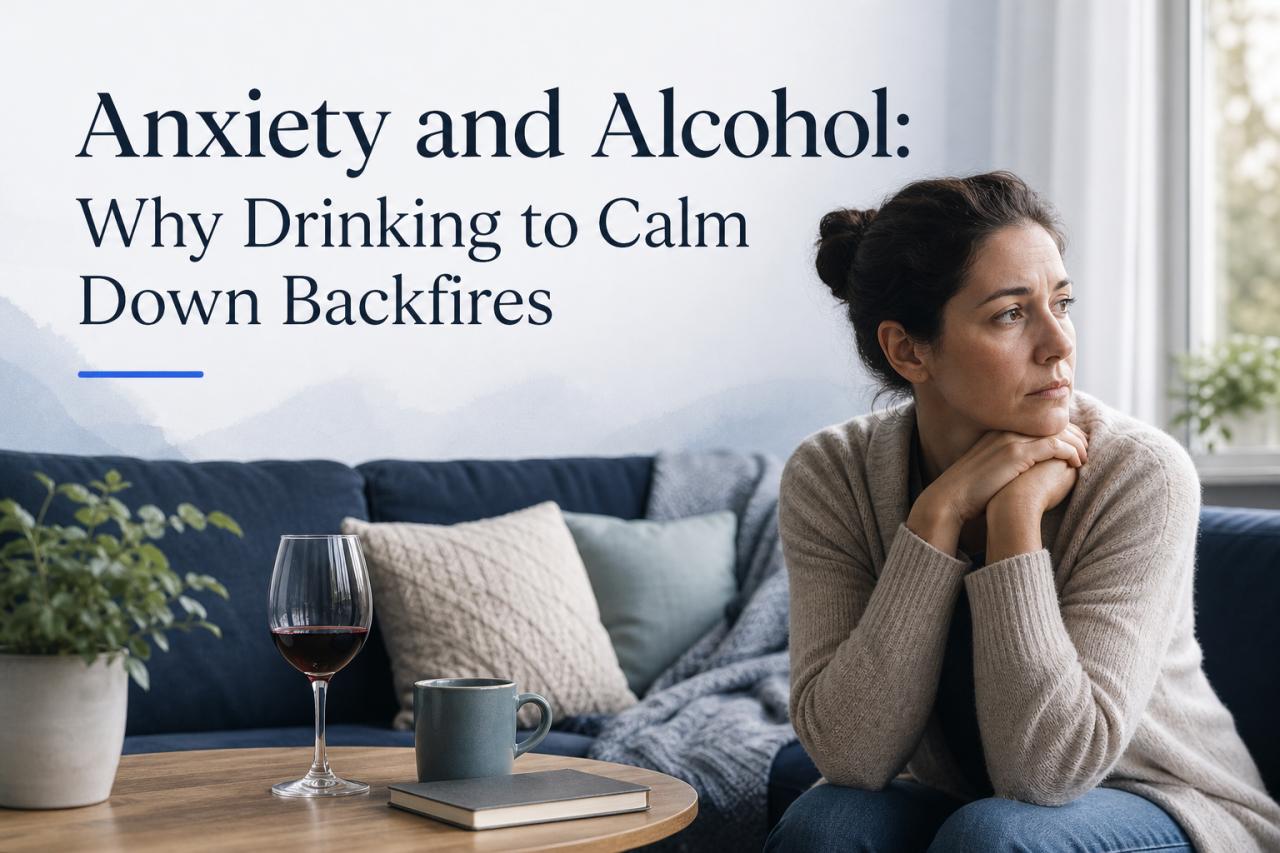
Drinking to settle anxiety is worth raising with a professional. Here is what an assessment covers and how structured outpatient care in Missouri works.
If you're drinking to calm your nerves, anxiety and alcohol may already be tangled together, and an assessment by a qualified professional can show how much each one is involved.
If you or someone else is in immediate danger, call 911. For 24/7 mental health or suicide crisis support, call or text 988 to reach the 988 Suicide & Crisis Lifeline.
How Anxiety and Alcohol Feed Each Other
Many people reach for a drink to take the edge off a tense meeting or a crowded party. If that becomes the main way you manage anxiety, it's worth bringing up with a professional (source).
If a drink is the only thing that gets you through dinners, work events, or time with friends, tell a clinician. A good one will ask about it without judgment, and you can say as much or as little as you're ready to.
Mental health and drinking are often treated together when both are present. Our guide to dual diagnosis treatment in Missouri covers how care for both conditions works.
Why Anxiety Can Feel Worse the Morning After
Some people wake up with a racing heart, dread they can't explain, and a replaying list of things they might have said the night before. If that sounds familiar, mention it to whoever evaluates you (source).
If your anxiety is worse after drinking, or you're reaching for a morning drink to settle shakiness or panic, raise it with a qualified professional soon (source).
Warning Signs Drinking to Cope Is Becoming a Problem
Planning your day around a drink, instead of having one only when anxiety hits, is worth mentioning to a professional. So is hiding how much you drink, drinking alone more often, or noticing that other ways of settling your nerves have dropped away (source).
Shaking, sweating, or a pounding heart on days when you haven't had a drink deserves a medical conversation. Speak with a medical professional before you cut back sharply (source).
You don't need to hit bottom before reaching out. An assessment by a qualified professional looks at your anxiety and your drinking, and you can ask for one while you're still working and still unsure whether it's a real problem.
If you've tried cutting back and the anxiety got louder, that's useful information, not a failure. Share it with whoever evaluates you. Our anxiety therapy services in Springfield are one place an evaluation can begin.
Stopping Safely When You Drink Heavily Every Day
If you drink heavily every day, talk with a doctor before you stop drinking, because sudden changes can be medically risky. Don't wait for symptoms to start.
A pounding heart and shaky hands in the first days without alcohol may be withdrawal rather than your baseline anxiety, and a medical professional can help decide whether you need medically supervised detox (source).
We don't provide medical detox or inpatient care, so if a doctor recommends it, we'll help you find a program that does. Detox addresses physical dependence, and many people continue into outpatient care afterward. Our alcohol rehab services in Missouri are structured outpatient programs, and an assessment can help sort out which level of care fits. The NIAAA publishes overviews of alcohol's effects on the body.
A few steps make the first conversation with a doctor easier. Write down roughly how much you drink and how often, without trimming the numbers. Note any shaking, sweating, or sleep problems on days you skip a drink, list any anxiety medications you take, and mention any past seizures or difficult withdrawals.
Please don't try to taper alone with a plan you found online. Work out the plan with a medical professional first.
Treating Anxiety and Drinking Together in Outpatient Care
Missouri Behavioral Health provides structured outpatient treatment for mental health conditions, substance use disorders, and co-occurring disorders. Co-occurring care means anxiety and drinking are looked at together instead of one being set aside while the other is treated.
It starts with an assessment. A qualified professional asks about your drinking patterns, your anxiety symptoms, your sleep, and your medical history, then recommends a level of care. Our options are Partial Hospitalization Program (PHP), Intensive Outpatient Program (IOP), and standard outpatient care, offered in person at our Springfield campus or through telehealth across Missouri. We confirm your actual days and hours after the assessment, so you can ask how it would fit around your job.
Your plan can include individual therapy, group support, medication management, and family involvement when it's clinically appropriate. You don't need to be sober on day one to begin an assessment. We use a trauma-informed, attachment-focused approach, which means we ask what's behind the anxiety rather than treating it as a flaw to push through.
Coverage depends on your plan and benefits. We don't accept Medicaid or Medicare, so verify your insurance before you decide, and our team will confirm what your plan covers. Admission is sometimes available the same day, though that's confirmed case by case.
Call Missouri Behavioral Health at 417-771-5305 for a confidential conversation about treatment options or to verify your insurance benefits.
Common Questions
How long does rebound anxiety last after drinking stops?
It varies from person to person. If anxiety stays high or gets worse over weeks, ask a qualified professional to evaluate it directly.
Can I get anxiety therapy while I'm still drinking?
Yes. You don't have to stop drinking before you start therapy or an assessment. Talking openly about your drinking helps the clinician build a plan that fits what's really happening. If the assessment shows you're drinking heavily every day, expect a conversation about medical supervision before you cut back.
Does alcohol interact with anxiety medications?
Ask your prescriber or pharmacist about it directly. Tell them exactly how much you drink, even if it's uncomfortable, and don't change or stop any prescribed medication on your own. For questions about medication at our programs, see our medication policy.
Is it normal for anxiety to feel worse in early recovery?
It's common for anxiety to be noticeable again once alcohol is no longer covering it. A qualified professional can help you build coping strategies while you adjust, and therapy for anxiety can run alongside treatment for drinking.
About the author
Missouri Behavioral Health
Editorial Team
Helpful educational resources from Missouri Behavioral Health.