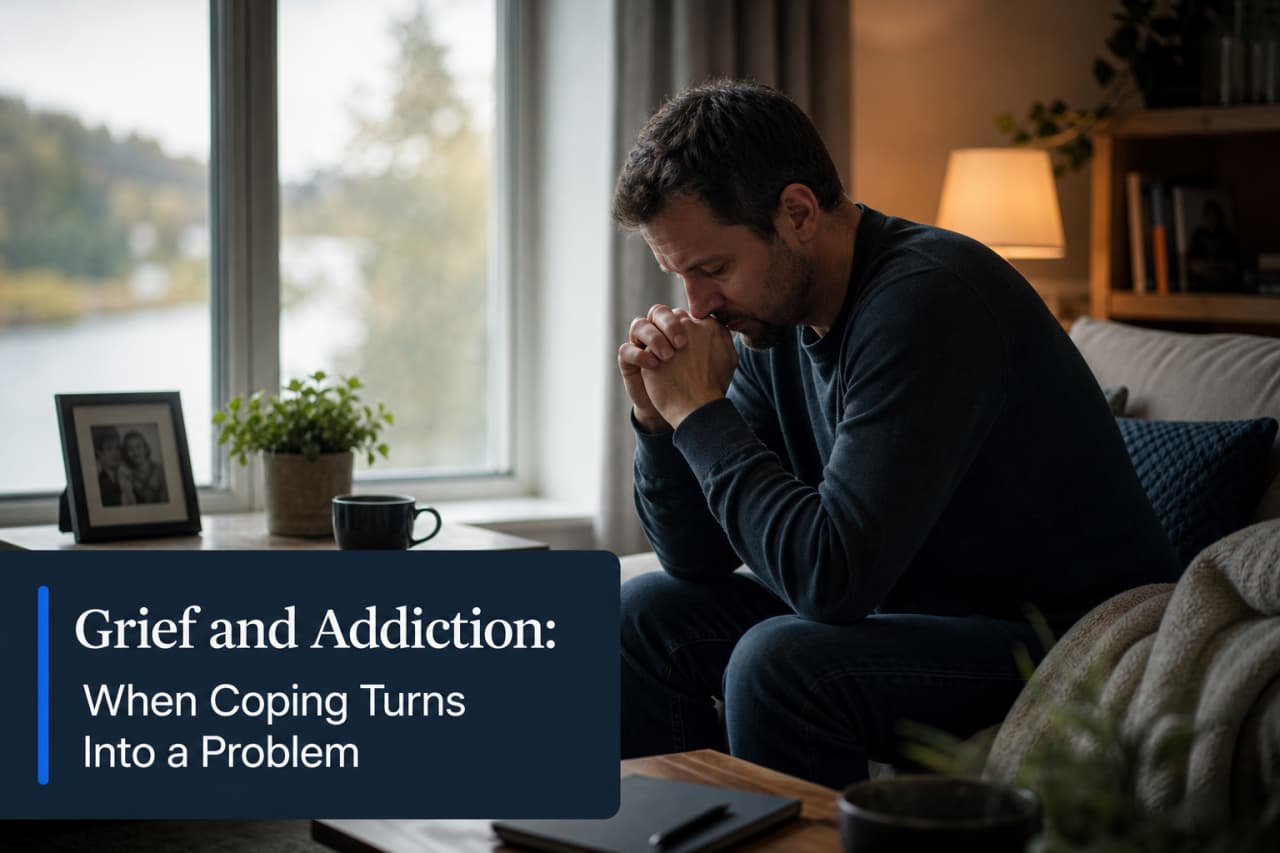
Loss pushes some people toward drinking or drug use.
Grief and addiction often develop together because alcohol or drugs can dull the pain of loss for a few hours, and the relief teaches the brain to reach for them again. If you've been drinking or using more since someone died, you're not weak, and this is a pattern that can change with the right support.
If you or someone you love is thinking about suicide or self-harm, call or text 988 any time, day or night. You can also chat with a trained crisis counselor at [988lifeline.org](https://988lifeline.org). If someone is in immediate danger, call 911.
How Grief and Addiction Feed Each Other
The cycle usually starts small. A glass of wine after the funeral, a pill to get through the night, a few extra drinks when the house goes quiet. The relief is real, so the habit gets reinforced. When the effects wear off the pain is still there and often feels sharper, which makes the next drink or dose look like the only thing that works.
Over weeks or months, that pattern can shift from coping into a substance use disorder. The substance also gets in the way of grieving itself. If you numb the feeling every night, you never get to move through it, and sleep, appetite, and mood tend to get worse, which deepens the sadness you were trying to escape.
Treatment works best when it covers both problems at once. When grief and addiction occur together, addressing only one without the other can be ineffective, because the unresolved loss keeps driving the use and the use keeps blocking recovery from the loss.
You don't need to work out which came first. At Missouri Behavioral Health, we treat substance use and mental health together, and an assessment with a qualified professional is how a care team sorts out what's going on and which level of care fits. If you're a family member watching someone pull away after a death, that same cycle may be what you're seeing. It's a natural response to loss that has gone somewhere harmful, not a character flaw.
Why Loss Leads to Drinking or Drug Use
Grief hits the body as well as the mind, and a drink or a pill is the fastest thing most people can reach for when sleep won't come or the chest feels tight. Counselors report that many clients turn to alcohol or drugs after a loss to numb the pain or get a temporary escape from grief. It's a common pattern, and it makes sense once you see what the substance is doing.
Three situations tend to push use higher. The first is the stretch right after a death, when arrangements, paperwork, and visitors keep you busy until the house empties. The second is a date that carries memory, such as a birthday, an anniversary, or the holidays, when an empty chair at the table is hard to ignore. The third is a loss other people don't treat as a real loss, like an estranged parent, a pet, a miscarriage, or someone who died of an overdose. When nobody around you acknowledges the grief, drinking alone can start to feel like the only place it's allowed.
Some people also carry older pain that a new death stirs up. A loss can reopen earlier trauma, which is one reason a trauma-informed approach matters in treatment. A clinician can ask about those layers without rushing you.
If you're a family member, you may notice the change before the person does. More drinking at night, missed work, or pulling away from friends after a death are worth taking seriously, and you can raise them with care rather than blame.
One practical point if drinking has become daily. Stopping suddenly can be medically risky, so talk with a doctor or a medical detox program before you cut back sharply. Our outpatient programs aren't medical detox, but we can point you to the right level of care when that's what you need.
Signs Coping Has Crossed Into a Problem
A good test is whether the substance still helps you get through grief or has started running your days. Drinking a little more in the first weeks after a death is common. It becomes a concern when you can't go an evening without it, or when you need more to get the same relief.
Some signs show up in behavior. You might hide how much you're using, drink or use alone, or keep a drink within reach at work, and missed shifts, late bills, and skipped meals with friends all count. Others show up in your body and mood, like shaking or sweating in the morning, trouble sleeping without a substance, or feeling anxious and low once the effects fade.
Another sign is that you've tried to cut back and couldn't. Addiction isn't a lack of willpower or a moral failing, and the brain's chemistry changes with repeated use, which is why stopping on your own is so hard. That's a medical reason to ask for help, not a reason for shame.
Family members often see the pattern first. They may notice that the person no longer talks about the loss, gets irritable when asked about drinking, or seems more withdrawn at gatherings. Grief that hasn't eased after many months, or that keeps you from basic daily tasks, deserves a conversation with a professional too.
You can't diagnose this yourself, and you don't have to. An assessment looks at your use, your mood, and the loss together, then recommends a level of care. If several of these signs sound familiar, that's reason enough to book one.
How Grief and Substance Use Are Treated Together
Treatment starts with one assessment that looks at your substance use, your mood, and the loss together, so you aren't sent to one provider for drinking and another for grief. When a person has a mental health condition along with an addiction, it's called a dual diagnosis, and treating both problems increases the chance of success. Our guide to dual diagnosis treatment in Missouri explains how that works in more detail.
Care happens in structured outpatient programs. Those include a Partial Hospitalization Program (PHP), an Intensive Outpatient Program (IOP), or standard outpatient care, in person in Springfield or by telehealth. IOP is typically planned at 9 to 15 hours per week, and we confirm your actual days and hours after your assessment. You keep sleeping at home, which suits many working adults.
Our approach is trauma-informed and attachment-focused. In practice, a therapist can work on the loss itself, including the guilt, anger, or relationships tied to the person who died, while teaching you ways to handle cravings and hard nights without a substance. Group sessions give you a place to say out loud what you've been carrying, and family involvement can be part of the plan when it's clinically appropriate.
You don't have to feel ready to talk about everything on day one. A good therapist lets you set the pace, and the first sessions often focus on stabilizing sleep, cravings, and daily routines before going deeper into the loss.
Many people ask whether grief counseling can start while they're still using. In an integrated program it can, because the two problems are treated at the same time. If you also need medication support, our medication policy explains how we handle it, and our overview of mental health treatment in Missouri covers depression or anxiety alongside the loss.
Gentle First Steps and Supporting a Loved One
Start with the smallest step that feels possible this week. Tell one person you trust that your drinking or drug use has picked up since the loss, and ask them to check in with you. If that feels like too much, write down how much you're using, how you're sleeping, and when the cravings are worst. A page of notes gives an assessor something concrete to work from.
Next, check your insurance. We offer insurance verification, and coverage and out-of-pocket costs depend on your plan and benefits. We don't accept Medicaid or Medicare, so it helps to know that before you call.
When you call, the admissions team will ask about your substance use, your mood, and what you've lost. Same-day admission may sometimes be available, though availability has to be confirmed for each person. Calling doesn't commit you to anything.
If a family member is the one who's struggling, start with a private, calm conversation rather than a confrontation. Say what you've noticed, such as more drinking at night or missed work, and say that you miss them. Skip labels like "alcoholic, " ask what the hardest part of the day is, then listen. Offer to sit with them while they call or to help look into insurance. You can't make someone start treatment, but a steady offer of help tends to land better than an ultimatum.
Look after yourself too. Loving someone who is grieving and using is tiring, and you may be grieving the same person.
Call Missouri Behavioral Health at 417-771-5305 for a confidential conversation about treatment options or to verify your insurance benefits.
Common Questions
Can grief lead to addiction?
Yes, grief can lead to addiction when drinking or drug use becomes the main way a person copes with loss. Not everyone who grieves develops a substance use disorder. The risk goes up when the pain is intense, support is thin, or the person already has a history of substance use or trauma. An assessment can sort out where you fall.
What's the difference between normal grief and prolonged grief disorder?
Normal grief comes in waves and gradually eases enough that you can handle daily life, even when it still hurts. Prolonged grief disorder is a diagnosis a qualified clinician makes when intense yearning or preoccupation with the loss lasts well beyond what's expected and keeps you from functioning. You can't diagnose it yourself, and it's treatable, so it's worth raising with a professional.
Can I start grief therapy before I've stopped drinking?
Yes, you don't need to be sober before you start talking with a therapist about your loss. Many people find the drinking and the grief are tangled together, so working on both at once makes more sense than waiting. If you're drinking heavily every day, check with a doctor first about whether stopping on your own is safe.
Do I need to attend a 12-step meeting to recover?
No, you don't need a 12-step meeting, though some people find them helpful. Support groups come in several forms, including 12-step, secular recovery groups, and groups focused on grief. Your care team can talk through which options fit your beliefs and schedule, and you can try a few before deciding. What helps most is finding people who understand both the loss and the substance use.
About the author
Missouri Behavioral Health
Editorial Team
Helpful educational resources from Missouri Behavioral Health.